


As parents we have been taught (and maybe raised) with the belief that strong boundaries drive strong children. But for some children, a directive like “put your toys away” or “turn the show off” goes further than a bit of disagreement. For some children with pathological demand avoidance, an immediate directive can trigger instant anxiety.
So, how can we as caregivers maintain those strong boundaries, while allowing that child the flexibility to make the right decision? And, of course, avoid the big feelings and emotions that come with anxiety over following through on our requests?
Pathological Demand Avoidance, or Pervasive Drive for Autonomy, is a psychological profile frequently exhibited by children with autism, though can present in children with anxiety, OCD, or ADHD. While many children may exhibit signs of rebellion or “strategic procrastination” when faced with a task they don’t wish to complete, this is different. Far different. For those with an anxiety-driven need for control, this type of demand or direction can feel like a direct threat to their autonomy.
You’ll note that the terminology for PDA is evolving. The shift from Avoidance to Autonomy moves the focus from a behavior problem to a nervous system need. By treating the underlying anxiety and approaching PDA from a clearer understanding that the child has less control/ownership/agency over their reaction to commands, we can approach children with PDA differently, shift our methodology, and increase our likelihood of success.
When a loss of control is seen as a danger
When a demand is made to a child with PDA, their amygdala can interpret that loss of control as a physical danger. The amygdala is the same portion of the brain well known for triggering the fight or flight reaction. Meaning, for those with Pervasive Drive for Autonomy, they are far more likely to entrench and react immediately to a demand in a more severe way. That reaction shows up as fight, flight, or freeze.
Fight: Argument, a meltdown, or explosive behavior.
Flight: Physically running away or using social distraction (e.g., changing the subject).
Freeze/Shutdown: Going limp, non-verbal, or an inability to process instructions at all.
Key Characteristics of Pathological Demand Avoidance
PDA goes beyond childlike disobedience or situational avoidance. PDA is characterized by:
- Resisting ordinary demands
- Activities like getting dressed, eating, or brushing teeth can feel impossible because they are required.
- Using social strategies as a defense
- Children with PDA are often very socially aware and may use role play, mimicry, or elaborate excuses to avoid a demand.
- High levels of anxiety
- Consider this: For children with PDA, avoidance is not a choice; it is a neurological necessity to lower extreme internal tension.
- A horizontal social identity
- Children with PDA typically do not recognize hierarchy. They view themselves as equal to adults, teachers, or bosses, and they respond much better to collaboration than to top-down authority.
Pathological Demand Avoidance and Creative Prompting
Simply put, to increase the likelihood of compliance, we as parents must shift our habits when raising children with PDA. While some may react to this shift, negatively, out of the need to maintain clear, strong boundaries (‘that’s not how I was raised!’), consider the benefits of shifting your prompts more creatively to achieve the same goal. (If you’re reading this, you are probably at the point where you’re ready to try anything!)
Instead of: “Put your shoes on, we’re leaving.”
Try: “We’re getting in the car in 5 minutes, is there anything you need to put on your body?”
Instead of: “Finish your homework”
Try: “I wonder how hard that math page is going to be tonight?”
Instead of: “Clean up your legos”
Try: “These legos hurt my feet when I step on them in the hallway.”
Instead of: “Put the tablet away. Now!” (We’ve all been there!)
Try: “I wonder how much time you need to get to a saving point?
Instead of: “Wash your hands for dinner”
Try: “The pasta you like is on the table. I am headed to wash my hands. Do you want to come with me to the sink or use the other sink?”
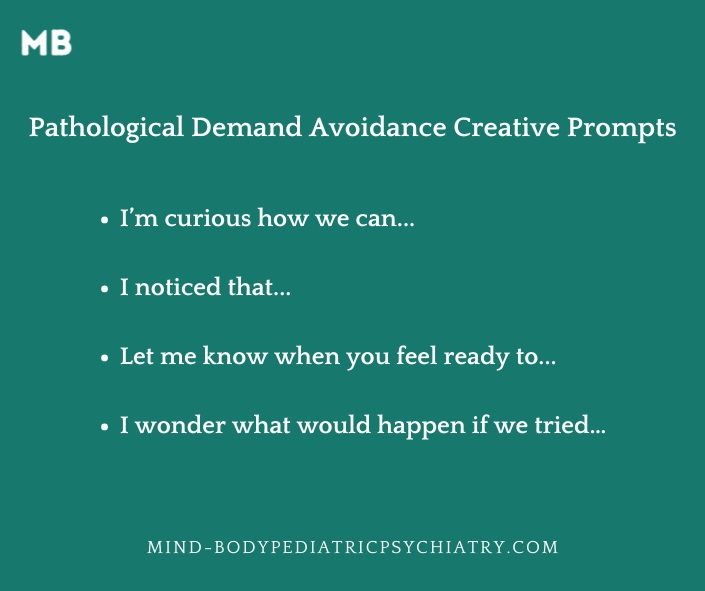
Examples of Invitational Language Prompts for Pathological Demand Avoidance:
Getting a handle on creative prompts is difficult, and can feel…a bit like a second language. When a transition is coming up, try using invitational language. This acknowledges that the child is an equal partner in the flow of the day.
- I’m curious how we can…
- I noticed that…
- Let me know when you feel ready to…
- I wonder what would happen if we tried…
Other Tips for incorporating more successful PDA prompts in your parenting:
- Reduce Eye Contact
- Sometimes, looking directly at a PDA child while giving a “demand” increases the threat. Try talking while you are both looking at something else.
- Use ‘We’ instead of ‘You’:
- ‘We need to get the groceries inside’ feels like a shared mission. ‘Pick up these groceries’ feels, to a child with PDA, like a demand.
- Use ‘I Wonder’:
- This is the most versatile tool in the PDA parent’s toolkit. It shifts the brain from “defend” mode to “solve” mode.
Creatively shifting your prompts to requests, for some, may feel like a retreat from the parenting plans you had for your child. And the learning curve to implement a more request-based approach may be significant. But, with practice, you may find that using more invitational language drives the behaviors you want, and less of the fight, flight, or freeze behaviors you’ve become accustomed to.
At Mind-Body Pediatric Psychiatry, we bring a holistic approach to our practice, partnering with parents on tactics and strategies that address medication, lifestyle support, and therapy. If you’re interested in learning more, set up a free :15 minute phone with us and we’ll discuss your unique needs.
This is general education, not to be mistaken for a patient-provider relationship. Please consult with your provider for more information.