


It’s rarely an instant, light bulb moment. For most parents it can be a quiet turmoil, hoping that things will improve, wondering if it’s ‘just a stage’, exhausting alternate options while there is a growing realization that your child and your family are struggling to keep things afloat. But deciding if you’re ready for pediatric psychiatric medication doesn’t have to be gut-wrenching. In fact, it’s just one tool in your toolkit to help your child better navigate life.
Our approach at Mind-Body Pediatric Psychiatry combines medication with lifestyle support and therapy. It’s truly a holistic approach that focuses on the total wellness of your child. And, maybe you’re not ready for medication. And that’s ok. But here are a few ways you know that it’s time to move from ‘unsure’ to ‘sure’ that you’re ready for pediatric medication:
You may be ready for pediatric psychiatric medication if…
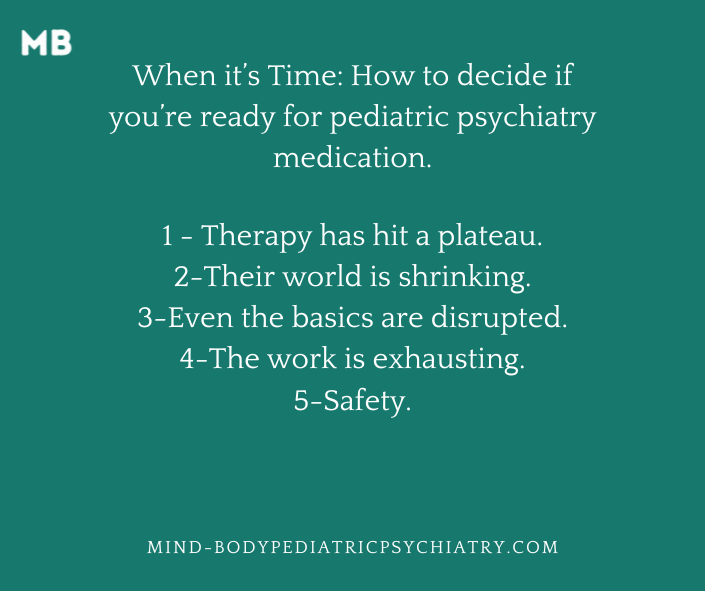
- Therapy Has Hit A Plateau
You and your child have been regularly attending therapy. They’ve worked on coping skills. You’re trying together to inject behavioral changes, but aren’t having much success with getting them to stick. As hard as you try, they just seem to fall off.
It may be a physiological hurdle…not just a lack of effort.
Sometimes the weight of anxiety, ADHD, or depression overpowers the tools their therapist is giving them. And, try as you might, you can’t find a foothold to overcome it. Medication can be that grip that allows the therapy to take hold, creating the mental space for your child’s therapy work to produce the desired effects.
- Their World is Shrinking
Take a hard look at your child’s daily life. Are they cutting back on the things they once loved? Insulating themselves from their friends and the activities that once brought them joy? Whether socially, academically, or retreating more inside the home, if your child is shrinking from the world, it may be time to add medication and give them the power to take that world back.
- Even the Basic Things are Disrupted
Sleep. Nutrition. Safety. Think back to Maslow’s hierarchy. A healthy childhood needs these basic building blocks. But when your child’s mental health consistently inhibits these basics, it can be an alarm to act. Without these core requirements, physical development and long-term wellbeing are at risk.
- The Work is…Exhausting
And yes, we mean completely exhausting. If your child is working twice as hard as their peers just to keep up, just to achieve a baseline of functioning, just to scrape by through another school day, it may be time to consider if you’re ready for pediatric medication. No child should have to feel like they are doing battle just to make it through another day at school.
- Safety Concerns
This one may go without saying, but if you have reached the point where you are concerned about the physical safety of your child (or yourself), it’s time. Whether from hurting others or self harm, toxic stress, or self-medicating, safety is the clearest of indications that all tools should be considered.
A Collaborative Path Forward, Where Pediatric Psychiatric Medication Plays a Part
Determining if you’re ready for pediatric medication is a deeply personal decision, but it doesn’t have to be an all-defining decision. At Mind-Body, we look at the whole child. We look at their environment, their physical health, their unique temperament. And if you decide you’re ready, medication becomes just a part of that world. It doesn’t mean that you’ve failed…it means that you’ve stepped up as a parent to provide them with the support that they need to succeed.
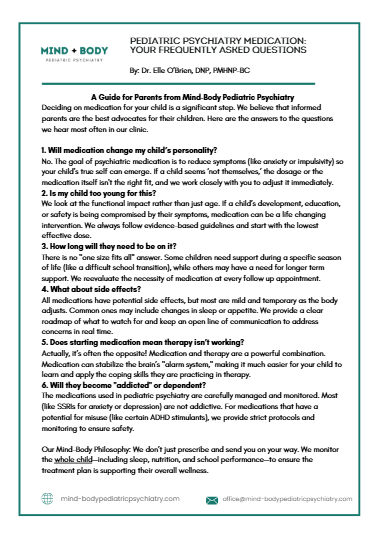
If you’re a parent in Chicago, Peoria, Springfield, or anywhere in Illinois, and you’re ready to consider broader alternatives like pediatric psychiatric medication, please see our full PDF of frequently asked questions below. Or consider setting a 15-minute discussion with us to learn more about the Mind-Body Pediatric Psychiatry approach, a holistic and evidence-based practice where medication is just one part of the plan.
This is general education, not to be mistaken for a patient-provider relationship. Please consult with your provider for more information.